Introduction
If someone asks “How Many Days Of Hanukka?” you want a short, clear answer followed by easy-to-follow steps, a simple history, and smart ideas for celebrating. This guide gives that short answer, explains why Hanukkah is eight days, shows how to light the menorah, and shares Europe-centered tips for food, travel, fashion, and family fun.
Quick facts — at a glance
- How Many Days Of Hanukka? — Eight days.
- Also called: Hanukkah or Chanukah (different spellings).
- Hebrew start date: 25 Kislev.
- 2025 example dates: starts at sundown December 14, 2025, and ends at sundown December 22, 2025.
- Main customs: nightly candle lighting, fried foods (latkes, sufganiyot), dreidel game, public menorah lightings.
Why is Hanukkah eight days?
Short story: Long ago, the Maccabees cleaned and rededicated the Jewish Temple. They found one small jar of holy oil for the Temple lamp. That oil should have lasted only one day, but it burned for eight days. People remember that as a miracle. Jewish teachers created an eight-day festival to celebrate that miracle.
A little more:
- The account is recorded in later Jewish writings and explained in rabbinic texts.
- Over time, the festival moved from temple rituals to family and community customs — songs, fried foods, menorah lightings, and games were added.
So when people ask “why is Hanukkah eight days?” the short, true answer is: because the oil lasted eight days and the festival remembers that miracle.
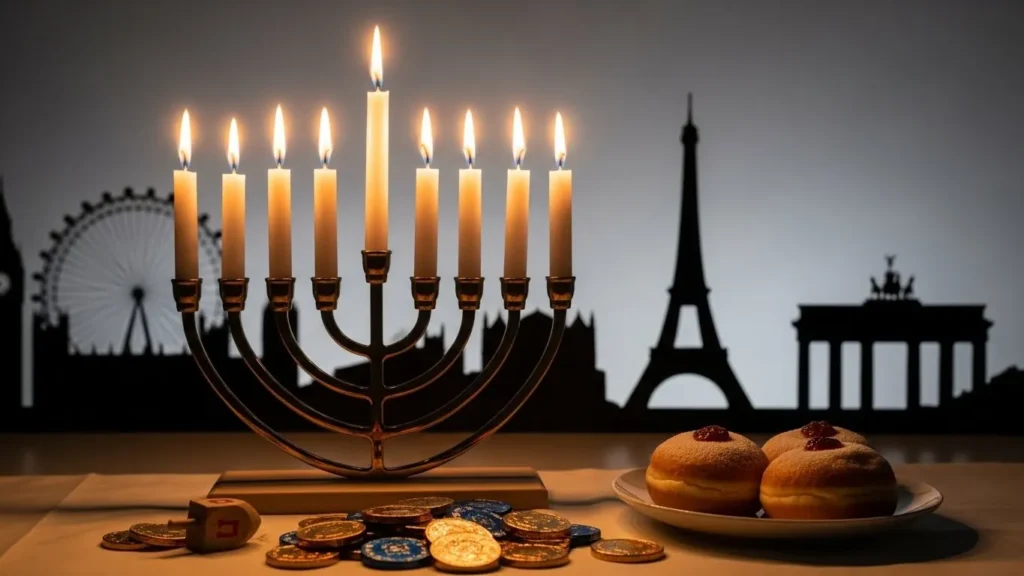
When does Hanukkah start and end?
Understanding the dates requires two calendars.
Hebrew vs. Gregorian: The Hebrew calendar is lunisolar — it follows both moon cycles and the solar year. Because of that:
- Hanukkah always begins on 25 Kislev (Hebrew calendar).
- The Gregorian dates move each year (usually late November to late December).
- Example: Hanukkah 2025 → Dec 14 (eve) to Dec 22, 2025
How to light the menorah (Hanukkah menorah lighting)
What you need
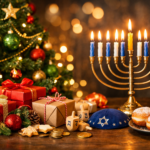
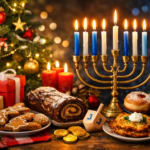
- A hanukkiah (nine-branched menorah: 8 candles + 1 shamash).
- Candles or oil cups that burn at least 30 minutes.
- Matches or a lighter and a safe, steady surface.
Steps to light (easy numbered list)
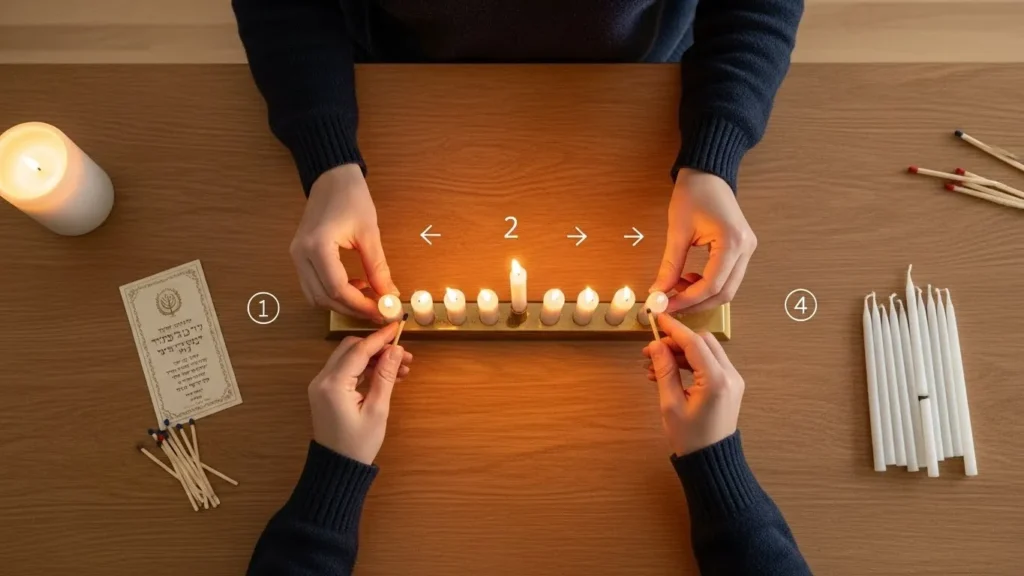
- Place the hanukkiah in a visible spot (near a window or by the doorway is common).
- Insert candles from right to left (as you face the menorah). On night one, put one candle in the right-most slot.
- Position the shamash (the helper candle) in its holder. The shamash lights the other candles. It is often separate (higher or lower).
- Light the shamash first, then recite the blessings. On the first night many people say three blessings; on later nights two.
- Light the candles from left to right, lighting the newest candle first. So on night two you light the second-night candle, then the first-night candle.
- Let the candles burn for at least 30 minutes. Do not leave them unattended.
How many candles do you need?
The “how many candles Hanukkah” question is common. Here’s the plain math.
- Not counting the shamash: total Hanukkah candles used over eight nights = 36 (1 + 2 + 3 + … + 8 = 36).
- Counting the shamash each night: many households also keep the shamash lit; the total then is 44 (2 + 3 + … + 9 = 44). Candle packs sometimes reflect these totals.
Candle math table
| Count type | Formula | Total candles |
| Hanukkah candles only | 1+2+…+8 | 36 |
| Hanukkah + shamash nightly | 2+3+…+9 | 44 |
Traditions, food and games (family & European flavour)
Hanukkah is both religious and very social. Food, games, music, and public events are part of the charm.
Food
- Latkes — fried potato pancakes, usually with applesauce or sour cream.
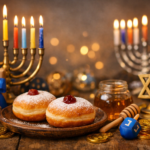
- Sufganiyot — jelly doughnuts, popular in many countries.
- Other fried dishes — food fried in oil remembers the oil miracle.
Games & music
- Dreidel — a spinning top with Hebrew letters; a fun game for children.
- Songs — Ma’oz Tzur is traditional; many modern covers exist. Include a playlist for readers.
Public events & markets
- Many cities host public menorah lightings in squares, museums, and civic places. These are family-friendly and great for photos.
European trend insights — where and how to celebrate
If you’re in Europe or planning a trip, these cities often have public celebrations and strong community events:
- London: big public menorah lightings (Trafalgar Square-style events), concerts, and family programs.
- Berlin: museum programs and public menorah displays; cultural events at Jewish museums.
- Paris: community lightings near tourist areas and synagogue events.
- Milan & Rome: active Jewish communities with food events and public gatherings; smaller historic Jewish towns also have year-round heritage.
Quick travel tips
- Book early for December events and dinners.
- Public menorah lightings are usually free — perfect for families and photographers.
- Try local bakeries for unique regional sufganiyot and baked goods.
Fashion & lifestyle — what to wear for Hanukkah in Europe
Hanukkah celebrations are relaxed but people like to dress nicely.
Outfit ideas
- Day event: warm layers — a smart coat, scarf, comfy boots.
Family dinner: smart-casual — a fine sweater or a dress with subtle metallic accents (gold or silver). - Evening public event: warm outerwear, hat, gloves; bring a festive accessory like a menorah pin or scarf.
Influencer ideas
- Create short reels: “8 Hanukkah looks” or “What to wear to a menorah lighting.” Partner with local designers for shoppable content.

Food & party planning — easy menu
A simple yet tasty menu makes any Hanukkah gathering special.
Menu suggestion
- Starter: mixed greens with citrus dressing.
- Main: roasted vegetables or brisket with a vegetarian option.
- Side: latke bar with toppings (applesauce, sour cream, smoked salmon).
- Dessert: sufganiyot or chocolate gelt.
Party
| Item | Why it helps |
| Hanukkiah + candles | Ritual centrepiece |
| Food station | Guests enjoy choosing toppings |
| Kids’ table | Keeps children engaged |
| Music playlist | Sets a festive mood |
| Photo corner | Content for social media |
Travel tips for Hanukkah in Europe
Want to see Hanukkah events? Here are practical tips:
- Book early — December is busy for winter events.
- Check local times — menorah lightings have set start times; some include concerts.
- Use public transport — city centres are easier by train or metro.
- Save money — attend free public events and buy from local bakeries for authentic treats.
Pros & Cons
Pros
- Visually rich — great for photos and video.
- Family-friendly — broad audience appeal.
- Local interest across European cities.
Cons
- Must be respectful and accurate — religion matters.
- Dates change yearly — content must be updated.
- Less commercial focus than other winter holidays — plan content carefully.
Table — Example: Hanukkah 2025 Quick Dates
| Year | Hebrew Start | Gregorian Start (Evening) | Gregorian End (Evening) |
| 2025 | 25 Kislev | Dec 14, 2025 | Dec 22, 2025 |
Full FAQ
A: Eight days (eight nights). It starts on the 25th of Kislev on the Hebrew calendar.
A: The tradition says a small jar of consecrated oil lasted eight days when the Temple was rededicated. This miracle became the reason for an eight-day festival.
A: In 2025, Hanukkah begins at sundown on December 14, 2025 and ends at sundown on December 22, 2025. (Check local community calendars for exact event times.)
A: If you count only the Hanukkah candles, total = 36. If you count the shamash each night, total = 44.
A: Communities have different customs. Often people light the menorah before Shabbat starts. Check Local Guidance for exact practice.
Conclusion
How Many Days Of Hanukka? is an easy question with a clear answer: eight. But as a publisher or event planner you can offer much more than a simple reply. Give your readers a Quick Facts box, a clear and friendly lighting tutorial, tasty recipes, local event guides, and downloadable assets. For European audiences, add city pages for London, Berlin, Paris, and Milan with local bakeries, public menorah events and travel tips.